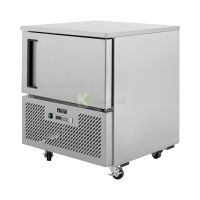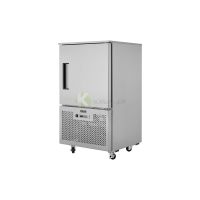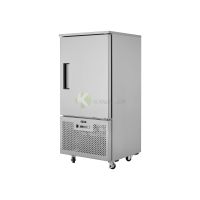
Blast Chillers & Shock Freezers
Commercial Blast Chillers & Shock Freezers for Kitchens
Commercial blast chillers and shock freezers are designed to lower food temperature during defined cooling or freezing cycles. Unlike conventional refrigerators and freezers that primarily hold food at storage temperatures, these appliances are used for controlled temperature reduction.
Kawader offers rapid cooling and freezing equipment in Saudi Arabia for restaurants, hotels, bakeries and central kitchens, with different tray capacities and operating functions.
Blast Chilling vs Shock Freezing
Blast Chillers
A blast chiller reduces food temperature to a specified chilled target during an operating cycle, subject to loading and food safety requirements.
Shock Freezers
A shock freezer is designed to achieve specified freezing temperatures during a defined cycle. Some models offer both chilling and freezing functions.
Why Central Kitchens Use Blast Chillers
Central kitchens may prepare food ahead of service and need a controlled process for reducing its temperature before storage or further handling.
Blast chilling equipment can support the cooling stage, but temperature checks, loading procedures and food safety records remain important.
How to Choose a Blast Chiller
Identify the food types, batch weight, initial product temperature and required target temperature. Compare tray quantity, tray dimensions, maximum load, declared cycle duration and electrical requirements.
Consider the available installation area and the workflow between cooking, rapid cooling and refrigerated storage.
Tray Capacity & Cooling Performance
Tray count alone does not determine how much food can be processed per cycle. Product weight, container depth and airflow between trays also matter.
Always use loading arrangements permitted by the manufacturer.
Blast Chillers vs Storage Freezers
Upright commercial freezers and horizontal freezers are primarily intended for frozen storage.
Blast chillers and shock freezers are selected for rapid temperature reduction, and chilled or frozen products may then require separate storage.
Applications in Professional Kitchens
Suitable applications may include certain cooked foods, prepared ingredients, bakery products and pastry components, depending on the model's technical specifications and approved cycles.
Businesses should select the appropriate process for each food type rather than treating every product the same.
Installation & Maintenance
Review the appliance's power requirements, dimensions, door clearance and ventilation instructions before installation.
Clean the chamber, trays, seals and food-contact components according to manufacturer instructions. Inspect temperature probes and controls where provided.
Key Features Before Buying
- Blast chilling and freezing functions.
- Tray count and format.
- Maximum batch capacity.
- Target temperatures.
- Declared cycle duration.
- Control and probe functions.
- Electrical power and voltage.
- External dimensions.
- Installation and cleaning requirements.
Why Choose Blast Chillers from Kawader?
Kawader offers rapid chilling and freezing equipment for commercial foodservice projects in Saudi Arabia. These units can be integrated with commercial freezer storage and refrigeration equipment.
Frequently Asked Questions About Blast Chillers
What is a blast chiller?
It is equipment designed to reduce food temperature during a controlled cooling cycle.
What is a shock freezer?
It is equipment designed for rapid freezing under specified operating conditions.
Can one unit provide both functions?
Some commercial models combine blast chilling and shock freezing.
Is a blast chiller a storage refrigerator?
Not necessarily. Its primary purpose is rapid temperature reduction.
How do I select tray capacity?
Review food volume, tray size and maximum load per cycle.
Are blast chillers suitable for central kitchens?
Yes, where the unit supports the kitchen's approved food cooling procedures.
Do all foods have the same cooling cycle?
No. Cooling conditions vary with food type, weight and initial temperature.
Can a blast chiller process cooked food?
Suitable models can support defined cooked-food cooling processes.
-
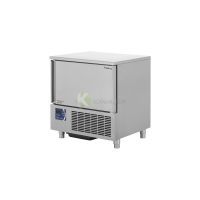 FriulinoxStainless Steel Blast Chiller - 5 Pans From FRIULINOXSpecial Price 18,773.26 Regular Price 22,086.19
-
 FriulinoxStainless Steel Blast Chiller - 8 Pans From FRIULINOXSpecial Price 23,459.69 Regular Price 27,599.63 Out of stock
-
 FriulinoxStainless Steel Blast Chiller - 12 Pans From FRIULINOXSpecial Price 30,568.07 Regular Price 35,962.43 Out of stock
-
 FriulinoxStainless Steel Blast Chiller - 12 Pans From FRIULINOXSpecial Price 35,290.21 Regular Price 41,517.90 Out of stock
-
 FriulinoxStainless Steel Blast Chiller - 16 Pans From FRIULINOXSpecial Price 43,848.47 Regular Price 51,586.44 Out of stock
-
 FriulinoxStainless Steel Blast Chiller - 24 Pans From FRIULINOXSpecial Price 58,649.21 Regular Price 68,999.07 Out of stock
-
 MastercoolStainless Steel Blast Chiller - 10 Pans From MASTERCOOLSpecial Price 22,480.38 Regular Price 26,447.52 Out of stock
-
 MastercoolStainless Steel Blast Chiller - 5 Pans From MASTERCOOLSpecial Price 14,476.64 Regular Price 17,031.34 Out of stock