
Central Kitchen Equipment: A Guide for High-Volume Production





Central Kitchen Equipment: A Guide for High-Volume Production
Central kitchens are designed for large-scale food production. Unlike a standard restaurant kitchen that serves one outlet, a central kitchen may support multiple branches, hotels, catering operations, cloud kitchens, or institutional foodservice projects. This makes equipment selection more critical, because every machine must support volume, consistency, workflow, and reliable daily operation.
Choosing the right central kitchen equipment helps improve production speed, control food quality, reduce waste, and organize labour more efficiently. It also allows businesses to standardize recipes and processes across multiple locations. Whether the kitchen prepares finished meals, semi-prepared ingredients, sauces, bakery items, frozen products, or ready-to-distribute food, the setup must be planned around output and workflow.
In this guide, we cover the main equipment categories required for high-volume kitchen equipment planning, including preparation, cooking, refrigeration, storage, transport, warewashing, and layout considerations for a professional commercial kitchen setup.
What Is a Central Kitchen?
A central kitchen is a production facility used to prepare food in large quantities before distributing it to branches, service points, events, or customer locations. It may prepare complete meals or support outlets by producing sauces, chopped ingredients, marinated products, dough, bakery items, or ready-to-cook components.
Central kitchens are commonly used by:
- Restaurant chains.
- Hotels and resorts.
- Catering companies.
- Cloud kitchen operators.
- Supermarkets and food retail businesses.
- Bakeries with multiple outlets.
- Institutional foodservice providers.
- Meal preparation and delivery businesses.
The main goal is to centralize production, improve consistency, and reduce pressure on individual outlets. When production is managed from one organized facility, businesses can control recipes, labour, purchasing, storage, and quality more effectively.
Why Central Kitchens Need High-Volume Equipment
A central kitchen works differently from a small restaurant kitchen. It usually handles larger batches, longer preparation cycles, more staff, and higher storage requirements. For this reason, equipment must be selected for continuous production and not only for occasional use.
High-volume kitchen equipment should support:
- Large batch preparation.
- Consistent cooking results.
- Fast cooling and organized refrigeration.
- Safe handling of raw and cooked products.
- Efficient movement of food between zones.
- Reliable warewashing and cleaning.
- Clear workflow between preparation, cooking, packing, and dispatch.
If equipment capacity is too low, the kitchen may face production delays, inconsistent output, and staff bottlenecks. If the equipment is too large for the actual output, it may waste space, energy, and budget. The best setup is one that matches real production needs with room for reasonable growth.
Planning the Preparation Zone
The preparation zone is one of the most important areas in any central kitchen. This is where ingredients are washed, cut, mixed, portioned, marinated, weighed, and organized before cooking or packing. Because production volumes are high, manual preparation alone is often not practical.
Central kitchens usually need preparation equipment such as mixers, vegetable cutters, meat preparation tools, food processors, stainless-steel worktables, weighing scales, and ingredient containers. Using commercial food-preparation equipment helps reduce manual labour, improve consistency, and speed up repetitive tasks across large production batches.
When selecting preparation equipment, consider:
- Daily ingredient volume.
- Type of ingredients used.
- Batch size.
- Staff workflow.
- Cleaning requirements.
- Food safety separation between raw and ready-to-use products.
- Whether the kitchen prepares for one outlet or multiple branches.
A well-planned preparation area reduces delays in the cooking line and helps maintain consistent product quality.
Mixers, Cutters, and Batch Preparation
High-volume kitchens often need mixers and cutters that can handle repeated daily use. For bakeries, pizza operations, pastry production, or dough-based menus, mixers must be selected based on dough type and batch size. For restaurants and catering kitchens, cutters and food processors help prepare vegetables, sauces, fillings, and base ingredients more efficiently.
Common preparation equipment may include:
- Planetary mixers.
- Spiral mixers for dough.
- Vegetable cutters.
- Food processors.
- Meat preparation equipment.
- Stainless-steel preparation tables.
- Ingredient bins and containers.
- Portioning and weighing tools.
The goal is not only to increase speed but also to standardize output. Consistent cutting, mixing, and portioning make it easier to control recipes and reduce product variation between branches.
Cooking Equipment for Central Kitchens
Cooking equipment in a central kitchen must support large volumes while maintaining consistent results. Depending on the production model, the kitchen may require tilting kettles, ovens, ranges, high-capacity fryers, steam equipment, grills, or specialized cooking units.
When choosing cooking equipment, consider:
- Type of food being produced.
- Batch size per cycle.
- Number of production cycles per day.
- Energy source available.
- Heat control and consistency.
- Cleaning and maintenance requirements.
- Space available for safe operation.
- Staff skill level and training needs.
For kitchens that produce bakery items, bread, pizza bases, or tray-based products, a 3-deck 9-tray electric deck oven can support repeated production cycles while using vertical space efficiently.
Cooking equipment should be selected as part of a complete workflow. It must connect smoothly with preparation, cooling, packing, storage, and dispatch.
Tilting Kettles, Ovens, and High-Capacity Fryers
Central kitchens often prepare soups, sauces, rice dishes, stews, fried items, or baked products in large volumes. This creates a need for equipment that can handle larger batches without compromising quality.
Tilting kettles may be useful for liquid or semi-liquid items such as soups, sauces, and cooked fillings. Ovens support bakery, pastry, roasted items, and tray-based production. High-capacity fryers help with fried chicken, appetizers, potatoes, or other fried products when output is high.
Before selecting these machines, review:
- Required production volume per hour.
- Type of food and cooking method.
- Time needed per batch.
- Labour required to load and unload the equipment.
- Cleaning process after production.
- Safety around hot surfaces, oil, or steam.
- Compatibility with the kitchen’s ventilation and utilities.
A central kitchen should avoid relying on equipment that cannot recover heat quickly or maintain stable performance during long production runs.
Refrigeration and Freezer Storage
Refrigeration is essential in any central kitchen because large quantities of raw ingredients, prepared items, sauces, cooked products, and semi-finished food need to be stored safely and efficiently. A weak refrigeration plan can lead to stock confusion, quality issues, and workflow disruption.
Central kitchens may need upright refrigerators, undercounter refrigerators, blast chillers, freezers, cold rooms, and organized cold storage areas. For kitchens that require frozen or chilled storage at scale, choosing a suitable 2-door upright freezer or related cooling solution can support better stock organization and easier access during production.
When planning refrigeration, consider:
- Raw ingredient storage.
- Prepared ingredient storage.
- Finished product storage.
- Separation between raw and ready-to-eat items.
- Delivery frequency.
- Production schedule.
- Stock rotation.
- Space for future growth.
Refrigeration should be located logically in the workflow. Ingredients should move from storage to preparation, then cooking, cooling, packing, and dispatch with minimal backtracking.
Storage Equipment and Stock Organization
A central kitchen requires organized storage for dry goods, packaging, utensils, trays, cleaning items, and finished products. Poor storage planning can slow down production and make inventory control more difficult.
Important storage equipment may include:
- Stainless-steel racks.
- Dry storage shelving.
- Ingredient bins.
- Mobile racks.
- Tray racks.
- Storage containers.
- Separate zones for packaging materials.
- Dedicated areas for cleaning supplies.
Storage should support stock rotation and easy access. High-use ingredients should be close to the preparation area, while bulk stock can be stored in a separate organized zone. Finished products should also have clear holding or dispatch areas to avoid confusion.
Transport and Internal Movement
Transport is a major part of central kitchen operations. Food and ingredients may need to move between storage, preparation, cooking, cooling, packing, and dispatch. Without the right transport equipment, staff may waste time carrying items manually or moving products unsafely.
Useful transport equipment includes:
- Service trolleys.
- Tray trolleys.
- Mobile racks.
- Ingredient carts.
- Food transport containers.
- Utility trolleys.
- Dispatch carts.
When choosing transport equipment, consider load capacity, route distance, floor layout, door widths, and whether the products need to remain hot, chilled, or protected during movement.
Internal movement should be planned to reduce cross-traffic between raw ingredients, cooked products, clean equipment, and waste areas.
Warewashing and Cleaning Equipment
Warewashing is often underestimated in central kitchen planning, but it has a direct impact on productivity and hygiene. High-volume kitchens use large numbers of trays, containers, utensils, mixing bowls, pans, racks, and service tools every day.
A suitable warewashing area may include:
- Commercial dishwashers.
- Pre-rinse stations.
- Stainless-steel sinks.
- Sorting tables.
- Drying racks.
- Clean storage areas.
- Waste handling points.
- Cleaning chemical storage.
The warewashing flow should move from dirty items to washing, drying, and clean storage without crossing into food preparation zones. This supports better hygiene and prevents bottlenecks during production.
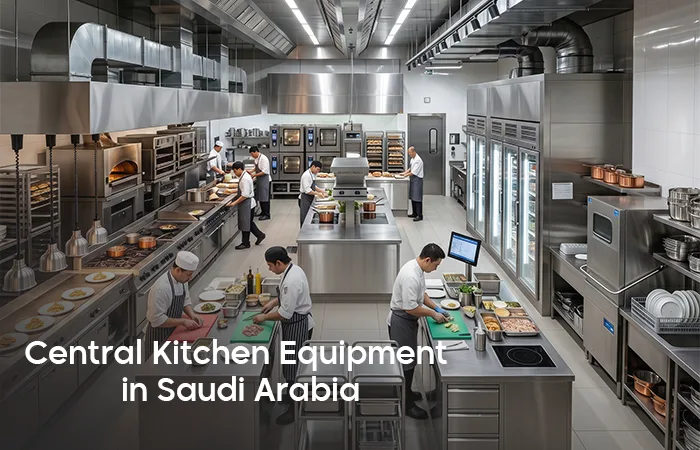
Workflow Planning for High-Volume Production
A central kitchen must be planned around workflow, not just equipment lists. Each area should support the next stage of production.
A practical workflow may include:
- Receiving.
- Dry, chilled, or frozen storage.
- Preparation.
- Cooking or baking.
- Cooling or holding.
- Portioning and packing.
- Dispatch.
- Warewashing and cleaning.
The layout should reduce unnecessary movement and separate raw, cooked, clean, and waste flows. A good workflow improves speed, safety, and product consistency.
Choosing Equipment by Required Output
The required output is one of the most important factors in central kitchen planning. Equipment should not be selected only by physical size or price. It should be selected by how much it can produce within the available working hours.
Before purchasing equipment, define:
- Number of meals or portions per day.
- Production hours available.
- Batch size required.
- Number of branches or service points.
- Storage needs before and after production.
- Staff capacity.
- Dispatch schedule.
- Expected growth over the next few years.
For example, a kitchen producing for one branch may need moderate capacity, while a central kitchen supporting multiple outlets needs higher-capacity preparation, cooking, refrigeration, and transport systems.
Common Mistakes in Central Kitchen Setup
Many production kitchens face problems because the setup was not planned around workflow and output. Common mistakes include:
- Buying equipment before defining production volume.
- Underestimating refrigeration and freezer space.
- Choosing mixers or cutters that are too small.
- Not planning transport routes inside the kitchen.
- Ignoring warewashing capacity.
- Placing storage too far from preparation areas.
- Mixing raw and cooked product flows.
- Not leaving enough space for staff movement.
- Buying equipment without considering cleaning and maintenance.
Avoiding these mistakes helps create a safer, faster, and more reliable production environment.
How Kawader Supports Central Kitchen Planning
Kawader Store provides commercial kitchen solutions for central kitchens, catering operations, hotels, restaurant chains, and high-volume foodservice projects. From preparation equipment and ovens to refrigeration, freezers, racks, trolleys, storage, and warewashing solutions, the right equipment plan can support consistent production and smoother daily operations.
Working with a specialized supplier helps businesses select equipment according to output, space, production type, and workflow requirements, instead of building a kitchen from disconnected equipment choices.
Conclusion
Central kitchen equipment should be selected around production output, workflow, storage needs, and food safety requirements. A successful commercial kitchen setup connects preparation, cooking, refrigeration, storage, transport, and warewashing into one efficient system.
Before purchasing equipment, define your required output, menu type, batch size, service model, and dispatch process. The clearer the plan, the more efficient and scalable the central kitchen becomes.
Contact Kawader to plan a central kitchen around your required output.