
Restaurant Equipment Brands: How to Choose by Category






Restaurant Equipment Brands: How to Choose by Category
Choosing equipment for a restaurant or commercial kitchen often begins with comparing brands. However, there is rarely one manufacturer that is the best choice for every part of a kitchen. A brand known for cooking equipment may not necessarily be the right choice for refrigeration, while a manufacturer specialising in coffee equipment may offer products designed for completely different operating requirements.
For this reason, comparing restaurant equipment brands should begin with the application rather than the brand name. Restaurant owners should evaluate how equipment will be used, how many hours it will operate, the production capacity required, maintenance needs, spare-parts availability, local technical support, and the overall project budget.
A category-based approach makes it easier to select equipment that fits the actual requirements of the operation rather than relying on general brand rankings.
Why There Is No Single Best Restaurant Equipment Brand
Commercial kitchens contain many different equipment categories, each operating under different conditions.
A fryer must maintain cooking temperatures during repeated batches. A refrigerator needs to maintain stable cold storage conditions despite frequent door opening. An espresso machine must deliver consistent extraction and steam performance, while a dishwasher needs to process repeated racks efficiently throughout service.
Because these requirements differ, commercial kitchen brands should be compared within their specific category.
Instead of asking, "What is the best restaurant equipment brand?" a more useful question is, "Which brand and model best fit this particular application and workload?"
Start with the Equipment Application
Before comparing manufacturers, define exactly what the equipment needs to do.
Consider:
- Menu and food type
- Expected daily production
- Peak-hour workload
- Available kitchen space
- Gas or electrical requirements
- Operating hours
- Staff experience
- Cleaning requirements
- Project budget
Two restaurants purchasing the same type of appliance may need completely different specifications because their menus and production volumes are different.
Comparing Cooking Equipment Brands
Cooking equipment includes fryers, grills, griddles, ranges, pasta cookers, salamanders, and other appliances exposed to intensive heat and repeated daily use.
When comparing cooking brands, evaluate:
- Construction quality
- Heating performance
- Temperature recovery
- Production capacity
- Control accuracy
- Energy source
- Cleaning requirements
- Availability of replacement components
Restaurants with intensive production should also consider whether a particular model is designed for continuous high-volume operation rather than occasional use.
Explore available cooking equipment brands and compare individual products according to your menu, production capacity, and kitchen workflow.
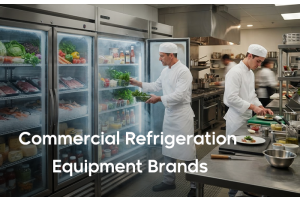
How to Compare Commercial Refrigeration Brands
Refrigeration has different priorities. Consistent temperature control, insulation, compressor performance, storage configuration, and suitability for the operating environment are more important than cooking speed or heat recovery.
When evaluating commercial refrigeration brands, consider:
- Temperature range
- Storage capacity
- Cooling performance
- Insulation
- Door configuration
- Energy requirements
- Ease of cleaning
- Maintenance access
Restaurants should also consider where the refrigerator will be installed. An undercounter unit positioned near a cooking line may operate under different conditions from an upright refrigerator installed in a dedicated storage area.
Browse available commercial refrigeration brands and select equipment according to capacity, application, and the conditions of your kitchen.
Food Preparation Equipment Requires a Different Comparison
Preparation equipment includes mixers, slicers, vegetable cutters, meat grinders, dough equipment, food processors, and other machines used before cooking begins.
For these categories, compare:
- Output per hour
- Motor performance
- Blade or attachment options
- Food-contact materials
- Safety features
- Ease of disassembly
- Cleaning requirements
- Replacement accessories
A restaurant processing small quantities of vegetables has very different requirements from a central kitchen preparing hundreds of kilograms of ingredients each day.
Capacity should therefore be based on realistic production requirements rather than selecting the largest available machine.
Coffee Equipment Brands
Coffee equipment is another category where specialised manufacturers can provide different advantages.
Espresso machines, grinders, brewing tools, and coffee accessories should be evaluated separately. A manufacturer known for espresso machines doesn't automatically need to supply the grinder or brewing accessories in the same coffee station.
When comparing coffee equipment brands, consider:
- Daily cup volume
- Peak-hour demand
- Brewing consistency
- Grinder accuracy
- Steam capacity
- Ease of calibration
- Cleaning requirements
- Spare-parts availability
- Technical support
Compatibility between the espresso machine, grinder, water system, and accessories should also be considered when designing the complete coffee station.
Ice Equipment Brands
Ice machines are frequently selected according to daily production capacity, but output alone doesn't provide the complete picture.
Restaurants should also consider:
- Ice type
- Production capacity
- Storage-bin capacity
- Water requirements
- Ambient operating conditions
- Cleaning procedures
- Maintenance requirements
A restaurant using ice primarily for beverages may have different requirements from a hotel, seafood display, or high-volume juice operation.
For seasonal businesses, peak summer demand should be considered when selecting production capacity.
Warewashing Equipment Brands
Dishwashing and glasswashing equipment should be evaluated according to throughput and workflow.
Important considerations include:
- Cycle duration
- Rack dimensions
- Racks per hour
- Water consumption
- Electrical requirements
- Wash and rinse performance
- Available kitchen space
- Cleaning and maintenance requirements
A small café may require a compact undercounter dishwasher, while a busy restaurant or hotel may need a higher-capacity hood-type system.
Choosing the appropriate configuration can have a major impact on labour efficiency and tableware availability during peak periods.
Reliability Should Be Evaluated by Application
Reliability is an important purchasing factor, but it should be considered within the intended operating environment.
A machine designed for moderate daily use may perform reliably in a small restaurant but become unsuitable when placed in a high-volume central kitchen.
When comparing brands, ask whether the specific model is designed for:
- Your daily production volume
- Continuous or intermittent use
- Your kitchen environment
- Your available utilities
- The required operating hours
This provides a more meaningful comparison than relying only on general brand reputation.
Spare-Parts Availability and Maintenance
Equipment eventually requires servicing, regardless of the manufacturer.
Before purchasing, check:
- Availability of common replacement parts
- Expected supply lead times
- Technical service availability
- Preventive maintenance requirements
- Warranty conditions
- Availability of consumable components
For equipment that is essential to daily production, fast access to spare parts can significantly reduce downtime.
Consider Warranty and Local Support
Warranty coverage should be reviewed alongside the purchase price.
Understand what the warranty includes, how service requests are handled, and whether technical support is available in your operating region.
Reliable local support can make a significant difference when equipment requires inspection, maintenance, or replacement components.
For this reason, evaluating restaurant equipment companies should include their after-sales capabilities, not only the brands or models they sell.
Does Country of Origin Matter?
Country of origin can provide useful context, but it shouldn't be the only factor used to judge equipment quality.
Different manufacturers may produce equipment for different price points, operating environments, and production requirements.
Instead of assuming one country automatically provides better equipment, compare:
- Specifications
- Materials
- Manufacturing standards
- Intended workload
- Warranty
- Maintenance requirements
- Spare-parts support
- Total cost of ownership
The most suitable choice is the equipment that meets your operational requirements reliably within the available budget.
Compare Brands Within the Same Category
A useful comparison should involve similar products designed for similar workloads.
For example, compare commercial fryers against other fryers with comparable capacity, or coffee grinders against grinders intended for a similar daily workload.
Avoid comparing brands only on reputation when their products serve different purposes or production levels.
This category-by-category approach produces a more accurate purchasing decision and reduces the risk of paying for capacity or features your restaurant doesn't need.
Balance Purchase Price with Long-Term Cost
The lowest initial price isn't always the least expensive option over the equipment's usable life.
Consider total operating costs such as:
- Energy consumption
- Preventive maintenance
- Replacement parts
- Cleaning requirements
- Downtime
- Labour efficiency
Likewise, the most expensive brand isn't automatically the best choice. A lower-capacity restaurant may receive little practical benefit from equipment designed for intensive production.
The goal is to find the best match between performance, reliability, support, and budget.