
How to Choose Restaurant Equipment for High-Volume Operations


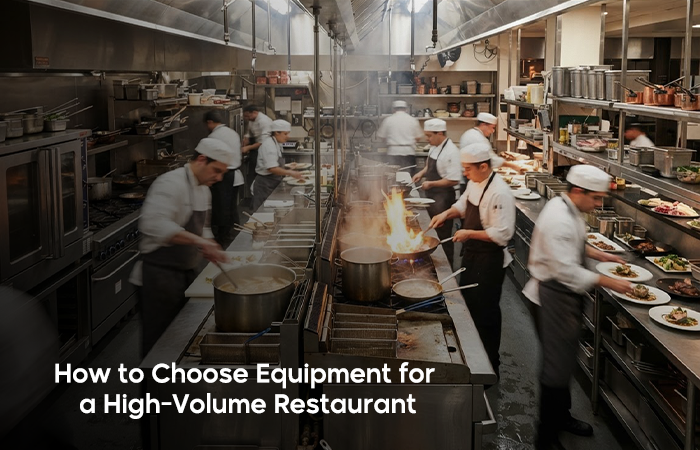
Running a high-volume restaurant places very different demands on kitchen equipment compared with a smaller food service operation. During peak periods, fryers may operate continuously, ovens can run batch after batch, refrigerators are opened frequently, and dishwashers must process large quantities of tableware without slowing down service.
For this reason, choosing high-volume restaurant equipment should be based on more than equipment size or maximum stated capacity. Restaurants need to evaluate practical output, recovery speed, durability, maintenance requirements, available utilities, and how each machine fits into the overall production workflow.
The right equipment helps maintain consistent food quality and service speed even when order volume reaches its highest point.
Start with Actual Order Volume
Before selecting equipment, determine how much your kitchen actually needs to produce.
Review factors such as daily orders, average covers, menu mix, takeaway and delivery volume, and expected future growth. More importantly, identify how those orders are distributed throughout the day.
A restaurant serving 500 customers evenly over twelve hours has different equipment requirements from a restaurant receiving a large percentage of its orders during a two-hour dinner period.
Understanding these patterns provides a more realistic picture of the restaurant production capacity required.
Identify Your Peak Service Periods
Average daily demand alone can be misleading when choosing commercial kitchen equipment.
Peak periods are usually where equipment capacity is truly tested. A fryer that performs comfortably during normal service may struggle when dozens of orders arrive within minutes.
Review your busiest:
- Lunch periods
- Dinner periods
- Weekends
- Holidays
- Delivery windows
- Seasonal promotions
Equipment should be selected to support these periods without consistently operating beyond practical capacity.
Calculate Practical Capacity, Not Just Maximum Capacity
Manufacturers often provide specifications such as litres, trays, racks per hour, kilograms per cycle, or daily ice production. These figures are useful, but they shouldn't be considered in isolation.
Practical output can also depend on:
- Cooking or processing time
- Loading and unloading time
- Product type
- Staff efficiency
- Recovery time
- Cleaning requirements
- Available preparation capacity
For example, a large fryer may have significant oil capacity, but its ability to recover temperature quickly after adding frozen food can have a major impact on actual hourly production.
Recovery Speed Matters in High-Volume Kitchens
Recovery speed describes how quickly equipment returns to its target operating conditions after a production cycle or heavy load.
This is especially important for fryers, ovens, grills, refrigeration systems, and dishwashers.
A fryer with fast temperature recovery can begin the next batch sooner while helping maintain consistent cooking results. Similarly, an oven that rapidly returns to the required temperature between loads can support more predictable production during continuous service.
Restaurants with intensive frying requirements can compare commercial fryers based on capacity, configuration, and their suitability for the expected kitchen workload.
Select Commercial Ovens for Your Production Style
Oven selection should reflect both the menu and the way food moves through the kitchen.
Restaurants producing large quantities of baked, roasted, or prepared dishes may require ovens capable of handling multiple trays or repeated cooking cycles.
Important considerations include:
- Tray capacity
- Temperature range
- Heating performance
- Cooking programmes
- Gas or electric operation
- Available kitchen utilities
- Required production volume
Explore commercial ovens to compare configurations suitable for different restaurant production requirements.
Consider Grill and Griddle Output
Grills and griddles are often central to burger restaurants, steak concepts, breakfast operations, and other high-volume menus.
A larger cooking surface allows staff to prepare multiple orders simultaneously, but size isn't the only consideration. Heat distribution and temperature recovery also influence practical production capacity.
Before purchasing, estimate how many menu items need to be cooked simultaneously during your busiest service periods.
Plan Refrigeration Around Accessibility and Capacity
High-volume refrigeration must do more than provide enough storage space.
Frequent door opening, large ingredient deliveries, and rapid stock turnover place additional pressure on refrigeration systems. Kitchens should therefore plan both bulk storage and easy access to ingredients at individual preparation stations.
Depending on the operation, this may involve combining upright refrigerators, freezers, undercounter refrigeration, and refrigerated preparation tables.
Placing frequently used ingredients close to the relevant workstation can also reduce staff movement and improve service speed.
Calculate Ice Production Carefully
Ice makers are another area where undersizing can quickly create operational problems.
Restaurants should estimate ice requirements based on beverages, food presentation, preparation needs, and peak customer demand rather than relying solely on average daily consumption.
Production capacity and storage-bin capacity should both be considered. During particularly busy periods, having sufficient stored ice can provide an important buffer between production and demand.
Dishwashing Capacity Can Affect the Entire Restaurant
Dishwashing is sometimes treated as a secondary consideration when designing a kitchen, but insufficient washing capacity can create a bottleneck that affects the entire operation.
When choosing a commercial dishwasher, evaluate:
- Rack capacity
- Cycle duration
- Racks per hour
- Available space
- Water requirements
- Power requirements
- Peak table turnover
High-volume restaurants should select equipment capable of processing dirty dishes quickly enough to maintain a continuous supply of clean plates, glasses, and utensils.
Explore commercial dishwashers to compare solutions for different levels of restaurant throughput.
Choose Equipment Built for Intensive Use
High-capacity equipment should also be durable enough for demanding daily operation.
When evaluating heavy-duty kitchen equipment, look beyond production specifications and consider construction quality, ease of cleaning, component accessibility, and the manufacturer's recommended duty cycle.
Equipment that performs well at maximum capacity for short periods may not necessarily be suitable for continuous operation throughout a long service day.
Consider Maintenance and Spare Parts Availability
Every commercial appliance requires maintenance eventually, and downtime is particularly expensive for high-volume restaurants.
Before purchasing equipment, ask:
- Are spare parts readily available?
- Is technical support accessible?
- How frequently is preventive maintenance required?
- Are common components easy to replace?
- How long could a typical repair take?
Reliable technical support and spare-parts availability can be just as important as initial equipment performance.
Identify Critical Equipment and Plan Backup Capacity
Some appliances are so important that a single failure can interrupt the entire service.
These may include:
- Fryers in a fried-food concept
- Pizza ovens in a pizzeria
- Ice makers in a beverage-heavy restaurant
- Refrigeration systems
- Dishwashers
For critical production areas, consider whether two appropriately sized units might offer greater operational security than relying on one machine for the entire workload.
Backup capacity doesn't necessarily mean duplicating every appliance. It means identifying which equipment failures would have the greatest operational impact and planning accordingly.
Avoid the Risks of Undersized Equipment
Choosing smaller equipment may reduce initial investment, but it can create significant long-term problems if production requirements exceed capacity.
Potential consequences include longer customer waiting times, inconsistent food quality, excessive equipment wear, higher maintenance requirements, and staff constantly working around production bottlenecks.
Equipment that repeatedly operates at or beyond its practical capacity may also experience greater stress and more frequent downtime.
At the same time, unnecessarily oversized equipment can increase purchase costs, energy consumption, and space requirements. The goal is therefore not simply to buy the largest machine available, but to select capacity based on realistic operating demand.
Build Capacity Around the Complete Workflow
A high-volume kitchen performs best when all production stages are balanced.
Installing an extremely high-capacity fryer won't solve service delays if preparation, refrigeration, holding, packaging, or dishwashing cannot keep pace.
Evaluate the complete workflow from receiving ingredients to serving the finished order. Each workstation should support the next without creating unnecessary waiting or congestion.