
How to Compare Restaurant Equipment Quotations Correctly





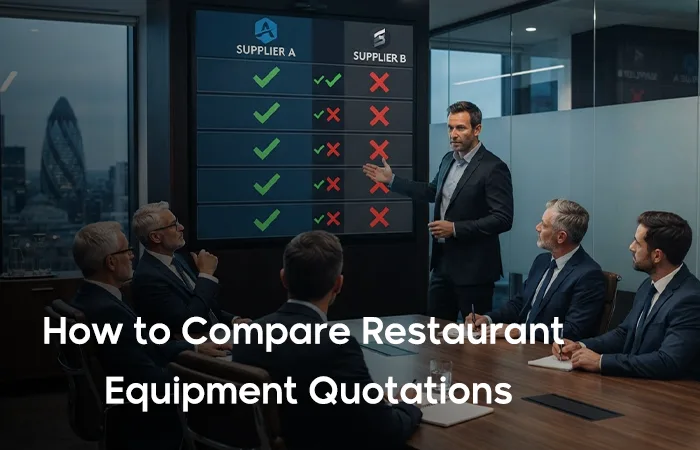
When planning a new restaurant, café, bakery, or commercial kitchen project, comparing equipment quotations is an important step before making purchasing decisions. However, choosing the lowest price quotation does not always mean choosing the best value.
Restaurant equipment is a long-term investment that affects daily operations, production speed, food quality, and maintenance costs. A quotation should be evaluated based on the complete solution it provides—not only the final price.
A professional comparison should include equipment specifications, capacity, included accessories, installation requirements, warranty coverage, maintenance support, delivery terms, and total cost of ownership.
This guide explains how to compare restaurant equipment quotations correctly and identify the differences between suppliers before making a final decision.
Why Comparing Restaurant Quotations Is Important
Restaurant equipment quotations can look similar at first glance, but important differences may exist between offers.
Two suppliers may quote the same equipment category but provide different:
- Models.
- Production capacities.
- Materials.
- Power requirements.
- Included accessories.
- Warranty terms.
- Installation services.
- After-sales support.
A lower quotation may exclude essential items that will need to be purchased later, increasing the actual project cost.
A proper comparison helps you:
- Avoid unexpected expenses.
- Select suitable equipment.
- Understand value differences.
- Plan your project budget accurately.
- Reduce future operating issues.
Step 1: Standardize the Equipment List Before Comparing
The first step is creating a standard equipment list that every supplier must quote.
Do not compare quotations based on general descriptions such as:
- Oven.
- Refrigerator.
- Fryer.
- Mixer.
Instead, define exactly what you need.
A detailed request should include:
- Equipment category.
- Required capacity.
- Dimensions.
- Power requirements.
- Quantity.
- Preferred specifications.
- Required accessories.
For example, instead of requesting:
"Commercial refrigerator"
Specify:
- Number of doors.
- Storage capacity.
- Temperature range.
- Stainless-steel construction.
- Intended use.
A standard request ensures every supplier is quoting comparable products.
Step 2: Match Model Numbers and Specifications
One of the most important steps when comparing quotations is checking whether the quoted equipment is actually equivalent.
Different models can have significant differences in:
- Performance.
- Capacity.
- Build quality.
- Energy consumption.
- Features.
- Lifespan.
Always compare:
- Brand.
- Model number.
- Country of manufacture.
- Technical specifications.
A quotation should clearly identify the exact equipment model rather than only listing a product category.
Step 3: Compare Equipment Specifications
Specifications determine whether equipment can meet your operational requirements.
Important specifications include:
Capacity
Check:
- Production capacity.
- Storage capacity.
- Tray capacity.
- Cooking output.
- Daily production limits.
Equipment that is too small may slow operations, while oversized equipment may increase unnecessary costs.
Dimensions
Confirm:
- Width.
- Depth.
- Height.
- Required installation space.
Equipment must fit your kitchen layout and allow proper workflow.
Construction Materials
Compare:
- Stainless-steel grade.
- Internal components.
- Durability.
- Resistance to commercial use.
Professional kitchens usually require equipment designed for heavy daily operation.
Performance Features
Review:
- Temperature control.
- Heating power.
- Cooling performance.
- Automation features.
- Operating controls.
Step 4: Compare Power Requirements
Power specifications are often overlooked when reviewing quotations.
Check:
- Voltage.
- Frequency.
- Wattage.
- Phase requirements.
- Gas requirements.
For example, equipment designed for different electrical standards may require additional installation work.
Confirm that the equipment matches your project infrastructure before purchase.
Step 5: Review Included Accessories and Components
A major difference between quotations is often what is included.
Some suppliers may include essential accessories, while others may quote the equipment only.
Compare included items such as:
- Shelves.
- Trays.
- Racks.
- Filters.
- Installation accessories.
- Additional attachments.
- Control systems.
A lower quotation may become more expensive if required accessories are added later.
Step 6: Compare Cooking Equipment Quotations
Cooking equipment is one of the most important categories in restaurant projects.
Explore commercial cooking equipment when reviewing options for ovens, fryers, grills, ranges, and specialty cooking solutions.
When comparing cooking equipment quotations, check:
- Cooking capacity.
- Heating power.
- Gas or electric operation.
- Number of burners or cooking zones.
- Recovery speed.
- Included accessories.
- Maintenance requirements.
For example, two fryers may have the same appearance but different oil capacity, heating performance, and production output.
Step 7: Compare Refrigeration Quotations
Refrigeration equipment directly affects food storage, quality, and daily workflow.
Explore commercial refrigeration solutions when comparing refrigerators, freezers, display units, and preparation refrigeration.
Important comparison points include:
- Storage capacity.
- Temperature range.
- Compressor type.
- Energy efficiency.
- Door configuration.
- Internal organisation.
- Warranty coverage.
A refrigerator that appears cheaper may have lower capacity or higher operating costs over time.
Step 8: Review Delivery and Installation Services
Equipment cost is not always the final project cost.
A complete quotation should clarify:
- Delivery fees.
- Delivery timeline.
- Installation charges.
- Assembly requirements.
- Testing and commissioning.
- Site preparation requirements.
Installation is especially important for:
- Ovens.
- Refrigeration systems.
- Cooking lines.
- Large equipment.
A quotation without clear installation details may create unexpected expenses later.
Step 9: Compare Warranty and After-Sales Support
Warranty is an important factor when evaluating suppliers.
Review:
- Warranty duration.
- Covered components.
- Excluded parts.
- Service response time.
- Maintenance availability.
- Spare parts support.
Commercial kitchens depend on equipment availability. A breakdown during operation can affect revenue and customer service.
A supplier offering reliable after-sales support can provide better long-term value.
Step 10: Check Maintenance Requirements
Different equipment options may have different maintenance needs.
Compare:
- Cleaning requirements.
- Service frequency.
- Spare parts availability.
- Ease of maintenance.
- Expected lifespan.
Equipment that is easier to maintain can reduce downtime and operating costs.
Step 11: Identify Exclusions in the Quotation
Always review what is not included.
Common exclusions may include:
- Installation.
- Electrical work.
- Plumbing connections.
- Ventilation.
- Accessories.
- Spare parts.
- Training.
- Delivery fees.
Understanding exclusions prevents budget surprises after approval.
Restaurant Equipment Quotation Comparison Table
|
Comparison Factor |
Quotation A |
Quotation B |
|
Equipment model |
Check exact model |
Check exact model |
|
Brand |
Compare brand reputation |
Compare brand reputation |
|
Capacity |
Match production needs |
Match production needs |
|
Dimensions |
Verify kitchen fit |
Verify kitchen fit |
|
Power requirements |
Confirm compatibility |
Confirm compatibility |
|
Accessories included |
Review details |
Review details |
|
Delivery |
Check timeline and cost |
Check timeline and cost |
|
Installation |
Included or separate? |
Included or separate? |
|
Warranty |
Compare coverage |
Compare coverage |
|
Maintenance support |
Evaluate service |
Evaluate service |
|
Total ownership cost |
Calculate long-term value |
Calculate long-term value |
Price vs Total Cost of Ownership
Price is only one part of the purchasing decision.
The total cost of ownership includes:
- Purchase price.
- Installation costs.
- Energy consumption.
- Maintenance costs.
- Spare parts.
- Downtime risk.
- Equipment lifespan.
A cheaper machine may cost more over time if it requires frequent repairs or cannot handle production requirements.
Common Mistakes When Comparing Equipment Quotations
Avoid these mistakes:
Comparing Prices Without Comparing Specifications
A cheaper quotation may include lower-capacity equipment.
Accepting General Product Descriptions
Always request exact models and specifications.
Ignoring Installation Costs
The final project cost may increase if installation is excluded.
Overlooking Warranty Details
Short or limited warranties may create future expenses.
Choosing Equipment Below Required Capacity
Saving money initially can lead to slower operations later.
Not Considering Future Growth
Equipment should support business expansion.
Tips for Getting a Better Restaurant Equipment Quotation
To receive accurate quotations:
- Provide a detailed equipment list.
- Share your menu concept.
- Explain expected production volume.
- Include kitchen drawings if available.
- Ask for technical specifications.
- Request clear warranty details.
- Confirm delivery and installation terms.
A detailed request helps suppliers provide more accurate recommendations.
Why Choose Kawader for Restaurant Equipment Projects?
Kawader provides commercial equipment solutions for restaurants, cafés, bakeries, and foodservice projects.
With a wide range of cooking equipment, refrigeration solutions, preparation equipment, and professional kitchen products, Kawader helps businesses select equipment based on operational requirements rather than price alone.
A clear and detailed quotation allows project owners to understand exactly what they are investing in and make confident purchasing decisions.
Conclusion
Learning how to compare restaurant equipment quotations correctly helps business owners avoid costly mistakes and choose equipment that supports long-term success.
A complete comparison should include specifications, capacity, accessories, power requirements, installation, warranty, maintenance, and total ownership cost.
The best quotation is not always the cheapest, it is the one that provides the right equipment, reliable support, and the best value for your restaurant operation.
Request a clear and detailed quotation for your project equipment and choose commercial solutions designed for your business needs.